
Protecting your designs
Introduction
Design protection gives the design owner a monopoly in the visual features of shape, configuration, pattern and ornamentation of the design.
The design features of a product are its visual features which can refer to shape, three dimensional configuration, two dimensional pattern or ornamentation. In this information sheet, we talk about how to protect your unique design for a product. To protect the way that a product operates or works, registering a patent may be more appropriate. For more information on patents see Arts Law’s information sheet on Patents.
Two regimes of intellectual property rights can potentially be used to protect designs, namely:
- the copyright regime; and
- the design regime.
Some of the differences between design and copyright protection are as follows:
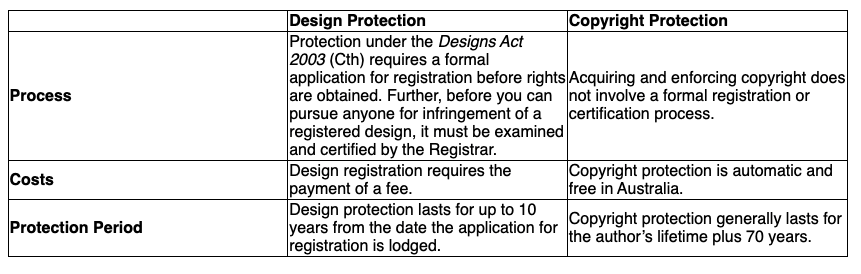
This information sheet is based on the Designs Act 2003 (Cth), which commenced on 17 June 2004. Designs registered under the old legislation (the Designs Act 1906 (Cth)) were largely unaffected by the Designs Act 2003 as validity and infringement of these designs were assessed using the old Act. The maximum period of design registration under the old Act was 16 years, it is unlikely any designs registered under the old Act remain in force.
- This information sheet also takes account of the amendments to the Designs Act 2003 introduced by the Designs Amendment (Advisory Council on Intellectual Property Response) Act 2021 (Designs Amendment Act). All changes introduced by the Designs Amendment Act would have come into effect by 11 March 2022.
Copyright Protection
Many designs for products will qualify as artistic works under the Copyright Act. Artistic works include paintings, drawings, sculptures and works of artistic craftsmanship (e.g., craft, jewellery, ceramics, woodworking, embroidery) and would include both design drawings and surface patterns such as designs for rugs or wallpaper. The following elements must be satisfied for a design for a product to be protected by copyright:
- It must fall within the definition of “artistic work” (namely a painting, drawing, photograph, sculpture, engraving, building or model of a building or work of artistic craftsmanship (what is a work of artistic craftsmanship is not defined);
- The artistic work must be in material form, not be merely an idea, concept or theory; and
The artistic work must be original. This means that the work must not be copied from another person and must originate from the person who claims copyright in the work.Copyright arises once these elements are satisfied; there is no requirement for registration in Australia.
Copyright protection in an artistic work generally lasts for the author’s lifetime plus 70 years.
Copyright is infringed if there is direct or indirect copying of a “substantial part” of the artistic work in which copyright subsists.
For more information on copyright, see Arts Law’s information sheet on Copyright.
Design Protection
Design registration protects the appearance of a product, not its function. The function of a product may be protected by a patent (see Arts Law’s information sheet on Patents for more information). The fact that the appearance or a visual feature of a product is associated with the function of a product does not disqualify it from registration. Unique shapes for cutlery handles or the backrest of a chair are examples of manufactured products where the design may also enhance the product’s function.
If a creator plans on making multiple copies of the product he or she has designed (e.g., furniture, jewellery, printed textiles or ceramics with an applied motif), the creator should consider the option of registering a design carefully.
An application to register a design is lodged with the Federal Government agency, IP Australia. Design protections lasts for 5 years from the filing date of the application for registration. You can renew your registration once to gain an additional 5 years of protection. To renew your registration, you will have to pay an additional fee. Information on current fees are available on the IP Australia website.
1. Registrable designs
In order to be registered, the design must consist of new and distinctive visual features of shape, configuration (3D), pattern or ornamentation (2D) of a product.
For a particular design to be “new” it must not be identical to:
- a design used publicly within Australia or published in a document anywhere in the world (the “prior art base”), before the application to register the particular design was filed; or
- a design disclosed in an earlier registered design application.
For a design to be “distinctive” it must not be substantially similar in overall impression to:
- a product design publicly used in Australia, or published in a document anywhere, before the application to register the particular design was filed; or.
- a design disclosed in an earlier registered design application.
Note that the above requirements are subject to a grace period.
Grace period
There will be a grace period for filing a design application, introduced by the Designs Amendment Act. This means that after 10 March 2022, if a design is publicly disclosed before an application is filed, the design owner will still be able to file a design application within 12-months of the disclosure, and the design will not be disqualified for not being new. The disclosure may be made by the designer, design owner or a person authorised by them. The grace period will also apply where there has been an unauthorised disclosure of the design by a third party but will not apply where the design was published by IP Australia or a design registration office overseas.
2. Rights of a registered owner of a design
The owner of a registered design has a monopoly over that design for a maximum period of 10 years.
The registered owner of a design has exclusive rights in respect of that design, including the right to:
- make a product that embodies the design;
- import, sell, hire or dispose of a product that embodies the design; and
- authorise others to do any of these things.
Further, the owner can assign (i.e., sell or transfer ownership) or license (i.e., permit use of) the right to exploit the design.
Importantly however, the owner cannot take legal action to prevent others from using the registered design until it has been examined.
If a design is used in the grace period, the owner will also not be able to take action for infringement for unauthorised use of the design in this period.
Who can register a design?
The following people can apply to register a design with IP Australia and become the “registered owner” of the design when it is granted:
- The designer (the person who created the design)
- If the designer created the design in the course of their employment, or under a contract (e.g., commissioned to create the design), the employer, or commissioner maybe eligible to register the design and become the registered owner, subject to agreement otherwise. The terms of the employment or commissioning contract will determine who is eligible to apply to register a design and be listed as owner on the Register of Designs.
- Any person the designer, employer, or commissioner assigns title to, or their legal personal representative (if the designer or commissioner is deceased).
More than one person can be registered as the owner of a design. Where there are multiple registered owners in respect of the same design, each owner is entitled to an equal, undivided share in the exclusive rights in the design, which they can exercise for their own benefit without accounting to the other owners (unless they have agreed otherwise).
However, none of the registered owners can, acting individually, grant a license or assign an interest in the design without the consent of all the other owners (unless they have agreed otherwise).
3. Applying for design protection
Application
To obtain protection for a design under the Designs Act, the owner must lodge a design application with the Designs Office at IP Australia.
Design applications must be in the prescribed form available from IP Australia and accompanied by representations of the design (drawings or photographs). A single application can be made to register multiple designs for one product or for multiple products if the design is a common design or if the products are in the same class under the Locarno Agreement (an international treaty establishing an international classification for industrial designs). The classification encompasses 32 classes and 219 subclasses, such as “means of transport”, “articles of clothing” and “musical instruments”.
After 10 March 2022, an eligible design will automatically be registered 6 months after filing the application without a need for a request for registration. However, if the owner wants to register the design earlier, they will be able to file a request to do so.
Registration
The Registrar will perform a formalities check to ensure that the application contains the necessary information and representations. The design will be registered automatically if the application complies with prescribed formalities. This process is intended to be relatively inexpensive and straightforward. The Registrar of Designs does not undertake substantive examination (such as to assess whether the design is, in fact, new or distinctive). Registration however preserves the right of the designer to get the design certified at a later stage. Certification is necessary to take action for infringement of the registered design. For example, a fashion designer with several designs produced for a seasonal range could register a number of designs and then have the commercially successful designs examined later (see below, Substantive examination).
It is recommended (but not mandatory) that a statement of newness and distinctiveness be filed when registering a design. This can streamline the later certification procedure. Such a statement must be provided by the applicant themselves and should systematically highlight those features of the design that constitute its newness and distinctiveness.
Once a design is registered, details of the registered owner(s) are entered on the Register of Designs.
Substantive examination
As mentioned above, the process of initial registration does not involve any substantive examination of the design. To enforce design rights against someone the owner of a registered design must request the Registrar of Designs to examine the design and certify its validity by issuing a certificate of examination.
The Registrar carries out a substantive examination of a registered design by comparing it to designs that existed before the design application was lodged. If the Registrar finds the design to be new and distinctive, a certificate of examination will be issued. The Registrar will remove the design from the Register if it is found to be invalid because it is not new and distinctive.
No legal action without examination
The registered owner of a design can only act against an infringer once a certificate of examination has been issued. Ideally, a registered owner ought to arrange for examination of the design as early as possible, in particular if the design would seem to be commercially valuable and successful. Otherwise, the owner may not be able to threaten or commence infringement proceedings against an alleged infringer immediately upon becoming aware of the allegedly infringing behaviour. Instead, the registered owner will need to wait until the design has been examined and found valid.
4. Infringing a registered design
A registered design is infringed if, without licence or authority of its owner, a person makes, sells, hires or imports a product, or uses for trade or business a product, embodying a design that is identical or substantially similar in overall impression to the registered design, or authorises a third party to do any of those acts.
Whether a design is considered identical or substantially similar to a registered design is determined on the basis of a visual comparison between the registered design and the allegedly infringing design. This assessment is made by reference to the “familiar person” – a person who uses the class of products in question and is “reasonably familiar” with the product. 1
Action for infringement
A design right is legally enforceable once the design has been certified. A person or company who has licensed all the rights to a design, to the exclusion of all others (exclusive licensee), including the owner of the design, also has the right to start infringement proceedings.
There is a time limit of 6 years from the date the alleged infringement occurred to begin infringement proceedings.
If the court finds that the design has been infringed, there are a number of possible remedies available:
- an injunction: an injunction means the court will order the person to stop the infringement; and
- Damages: a monetary amount paid for loss or harm caused by the infringement, or
- an account of profits: the person who has infringed your right has to pay you the profits they made from the use of your design.
However, the court may refuse to award damages or an account of profits if, at the time of the infringement, the infringer was not aware that your design was registered and had taken reasonable steps to work out whether the design they used was registered or not (see Innocent infringement).
5. Defences to design infringement
Spare parts
Under the Designs Act, a complete defence, known as the “spare parts” or “right to repair” defence, can be raised against an infringement claim when parts that are registered as designs are used (including manufacture and supply) for repair purposes. Under the Designs Act, “repair” broadly means restoring or replacing a decayed or damaged component part of a product. To satisfy the defence the product needs to be repaired and have its overall appearance restored in whole or in part by the allegedly infringing product.
The use of design-registered parts for non-repair purposes is still an infringement of the registered design. The registered owner of the design must prove that the person knew or ought to have known that the use or authorisation of use was not for the purpose of repair.
Innocent infringement
There is also a defence of ‘innocent infringement.’ A third party will not be liable for infringing a design if they did not know the design was registered. The third party must prove they did not know and had no reasonable way of knowing that an application for design registration existed.
This defence has been expanded to apply to the period between the filing date of a design application and the date of registration. During this period, the design is not publicly available on the Register of Designs, so a third party searching the Register may be unable to find out that a design is protected.
Prior use
Additionally, there is an exemption for prior use, which protects third parties who started using a design before the priority date of a registered design. This applies if the third party independently creates the design, or if they copy it from a disclosure by the owner before the priority date. This also protects people who legally obtained products from a third party, allowing them to use and sell those products without infringing the design.
Losing Copyright and/or Design Protection
The copyright and design regimes can both potentially protect the visual features of a product. However, the interplay between these two regimes means that either copyright protection or design protection (and sometimes both) may be lost in a number of ways:
- Unless dual protection is possible, copyright protection is lost on registration of a design;
- Once a product has been produced in industrial quantities, not only is copyright protection lost (unless it is a two-dimensional design, see Dual Protection) but it is no longer possible to register the design.
Dual Protection
Some product designs may be eligible for dual protection, i.e. protection under both the Copyright Act and the Designs Act. Dual protection is possible for designs of two-dimensional pattern or ornamentation that result in the reproduction of an artistic work when applied to the surface of an article – for example, a painting printed on a T-shirt or a motif repeated as a pattern for bed linen. If, however, a work has already been industrially applied and sold anywhere, it may not be registrable as a design as it would not be new and distinctive. Copyright protection alone may apply.
Design registration and loss of copyright protection
Generally, a creator will lose copyright protection in an artistic work when the artistic work (e.g. drawings for a cabinet or sketches for a coat) is registered as a design unless the artistic work involves two dimensional patterning or ornamentation. The registered owner of such designs can only rely on their rights under the Designs Act if cabinets or coats are made to that design without the design owner’s permission. Only the drawings themselves will still be protected by copyright, e.g., if directly copied.
Because design protection is only available if the design is new and distinctive, creators must register their designs before:
- Industrial application (defined as making more than 50) or publication of and commercial dealing with, products embodying the designs; or
- Use of the designs for products (as opposed to creation of the artistic works on which the design is based).
Use or exhibition of an artistic work which does not amount to industrial production or commercial use of the corresponding design in a product will not destroy novelty for the purposes of design registration. For example, if an artist exhibits a sculpture in a gallery and then chooses to produce lamp bases reproducing the sculptured form, then the fact that the artist had exhibited the sculpture in the gallery does not prevent the design for the lamp bases from being regarded as new.
Industrial application and loss of copyright protection
An important concept in this area is “industrial application”. Whether there has been industrial application of the design is a question of fact and depends on the circumstances. However as soon as a design is applied to more than 50 articles, or to one or more articles manufactured in lengths or pieces, it is regarded as “applied industrially” by law.
The publication in Australia of a patent specification or design representation by IP Australia or IP registration office overseas relating to an application to obtain patent or design rights for a product is also considered to be industrial application.
Creators cannot rely upon copyright to prevent others from making products which substantially reproduce their artistic work where:
- it is an artistic work which is neither:
- embodied in the product by way of two dimensional pattern or ornamentation; nor
- a work of artistic craftsmanship
- the creator has authorised a corresponding product design to be applied industrially (for example by producing more than 50 items of the product); and
- the resulting products are sold or let for hire, or exposed for sale or hire in Australia or anywhere.
For example, a sculpture which looks like a chair moulded to exhibit particular visual features of shape, such as a pair of lips, would normally be protected by copyright for the lifetime of the original artist plus 70 years. During that time, nobody can reproduce the sculpture without the permission of the copyright owner. However, if the artist allows his sculpture to be adapted into a chair for commercial production and 50 or more of these sculptured chairs are produced, the artistic work has been both embodied in a corresponding design and applied industrially. The artist will lose copyright protection as soon as those products are sold, let for hire or offered or exposed for sale or hire whether in Australia or elsewhere. This is so whether or not the design has been registered.
Works of artistic craftsmanship
A work of artistic craftsmanship applied industrially retains copyright protection unless it has been registered as a design. The Copyright Act contains no definition of works of artistic craftsmanship and a precise definition of the term has not been settled by case law. It is clear, however, that the work must be of artistic quality and involve craftsmanship.
- Artistic quality: To possess artistic or aesthetic quality, a work need not be one of fine art but must have more than mere visual appeal. It can also be functional such as a chair or a quilt.
Whether a work has sufficient aesthetic quality to be a “work of artistic craftsmanship” is determined objectively and is a question of fact. Expert evidence can be used to show the existence of artistic quality. The subjective intention of the creator has also been held to play an important – though not essential – part in resolving this question. The courts cannot rely solely on their own personal aesthetic judgment.
- Craftsmanship: The requirement of craftsmanship demands that the work reflects pride in sound workmanship and displays an exercise of skill by its creator in using materials to create the work and devices to transform the materials into the work. The concept of craftsmanship is not necessarily limited to handmade products. Products produced by machines qualify as works of craftsmanship when they result from the creator’s skill or involvement with the machinery, knowledge of the materials and pride in the workmanship. The more skill and involvement the creators show in the making of the work, the better chance it will qualify as a work of craftsmanship.
Creators have the choice about whether their work of artistic craftsmanship should be protected by copyright or design law. The choice of one regime or the other must, however, be made at an early stage.
Relying on Copyright Protection
Artists wishing to exploit their artistic work by embodying it in a design and producing a product range should be cautious about relying solely on copyright as copyright protection may be lost when the products are offered for sale. Unless the design is for two dimensional patterns or ornamentation, creators should consider registering their artistic work as a design before starting to apply it industrially. Though copyright protection will be lost on design registration, the creator will at least have rights under the Designs Act to protect their design.
Points to remember
- Designs can be protected under two regimes:
- The copyright regime; or
- The design regime.
- A creator wishing to protect a design needs to decide which regime is most suitable, based on the intended use of the design.
- A design must be new and distinctive to be registered under the Designs Act.
- The registered owner of a design must obtain a certificate of examination from the Registrar of Designs confirming that the design is valid to enforce design rights.
- Copyright protection or design protection (or both) may be lost in a number of ways:
- Unless dual protection is possible, the creator loses copyright protection (but gains design protection) once a design is registered
- The creator relying on copyright protection solely might lose that protection (and be precluded from design registration) when the design is applied industrially and the resulting products are sold or let for hire or offered for sale or hire.
Further information
- Arts Law Centre of Australia (www.artslaw.com.au), tel. (02) 9356 2566 or toll-free outside Sydney on 1800 221 457
- IP Australia (www.ipaustralia.gov.au), tel. 1300 651 010 for further information on design protection, including “A Guide to Designs”
- Australian Copyright Council (www.copyright.org.au), tel. (02) 8815 9777, for free fact sheets:
Disclaimer
The information in this information sheet is general. It does not constitute, and should be not relied on as, legal advice. The Arts Law Centre of Australia (Arts Law) recommends seeking advice from a qualified lawyer on the legal issues affecting you before acting on any legal matter.
While Arts Law tries to ensure that the content of this information sheet is accurate, adequate or complete, it does not represent or warrant its accuracy, adequacy or completeness. Arts Law is not responsible for any loss suffered as a result of or in relation to the use of this information sheet. To the extent permitted by law, Arts Law excludes any liability, including any liability for negligence, for any loss, including indirect or consequential damages arising from or in relation to the use of this information sheet.
© Arts Law Centre of Australia
You may photocopy this information sheet for a non-profit purpose, provided you copy all of it, and you do not alter it in any way. Check you have the most recent version by contacting us on (02) 9356 2566 or tollfree outside Sydney on 1800 221 457.
The Arts Law Centre of Australia has been assisted by the Commonwealth Government through the Australia Council, its arts funding and advisory body.